

Value vs. Cost of Heat Leak
Due to the extreme temperature difference between liquid nitrogen and ambient air, a large amount of heat will transfer even through a very short section of uninsulated or poorly-insulated pipe component very quickly. This can have a substantial impact on the entire system.
Even though the loss is not immediately visible nor is it significant for one day, but over time that loss can add up to thousands of dollars. Increased heat leak at any point in the system can cause two-phase fluid that increases pressure drop, causing irregular flow of liquid, which reduces the overall flow rate. Two- phase flow will create significantly higher pressure drops through the pipe system, irregular liquid delivery, results in warmer liquid at the cryogen use point and shortens the life of valve seats and other components within the system.

Case Study 1:
Consider a food production company that utilizes a 30-meter (100-foot) run of vacuum jacketed pipe (VJP), along with a 0.5-meter (2-foot) connection of foam-insulated pipe.
For the VJP with a diameter of 1.0 inch, the typical heat transfer rate is approximately 0.5W/m (0.52 BTU/hr/ft). Thus, the total heat leak for the 30-meter run of VJP can be calculated as 30 x 0.5 = 15W (52 BTU/hr).
On the other hand, for the foam-insulated copper pipe, the typical heat transfer rate is around 20W/m (20 BTU/hr/ft). Consequently, the heat leak for the 2-foot section of foam-insulated copper pipe can be determined as 0.5 x 20 = 10W (40 BTU/hr).
Result:
The 0.5m(2-foot) section of foam insulated copper pipe is responsible for 40% of the total heat transferred into the pipe.
Total heat leak for the 30m run of fully vacuum insulated pipe is 15W.
The heat leak for the 30m VJP system plus the 0.5m foam insulated copper pipe is 25W, which translated to 0.56L per hour of liquid nitrogen loss.
Case study 2:
A semiconductor plant is currently undertaking a project involving a 100meters (300ft) of 1.5″NB piping system to supply liquid nitrogen to six units of HALT/HASS equipment. They have received two quotations: one for a copper piping system with 3″ PU insulation priced at $40,000.00, and another for an SS304L vacuum insulated piping system priced at $160,000.00.
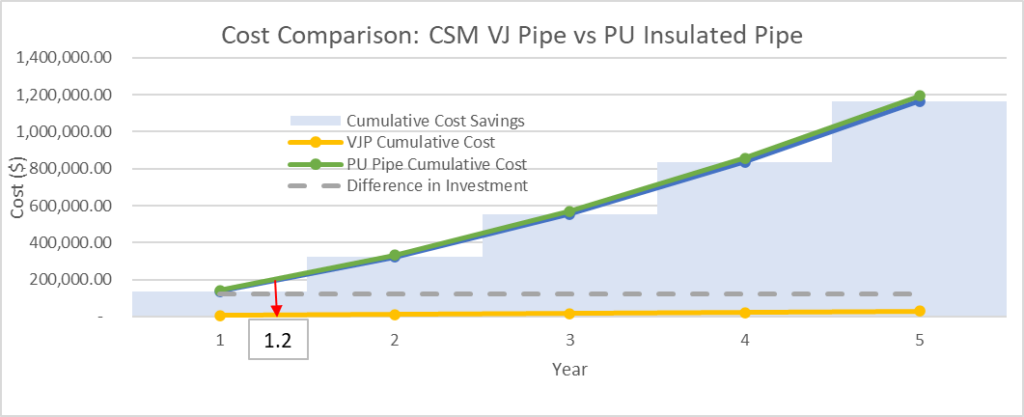
To conduct a ROI (Return on Investment) analysis, the project engineer needs to estimate the heat leaks and LN2 loss for both systems. The analysis is based on the assumption that the cost of LN2 will average $0.50 per Liter over the next ten years. The results of the analysis are presented below.
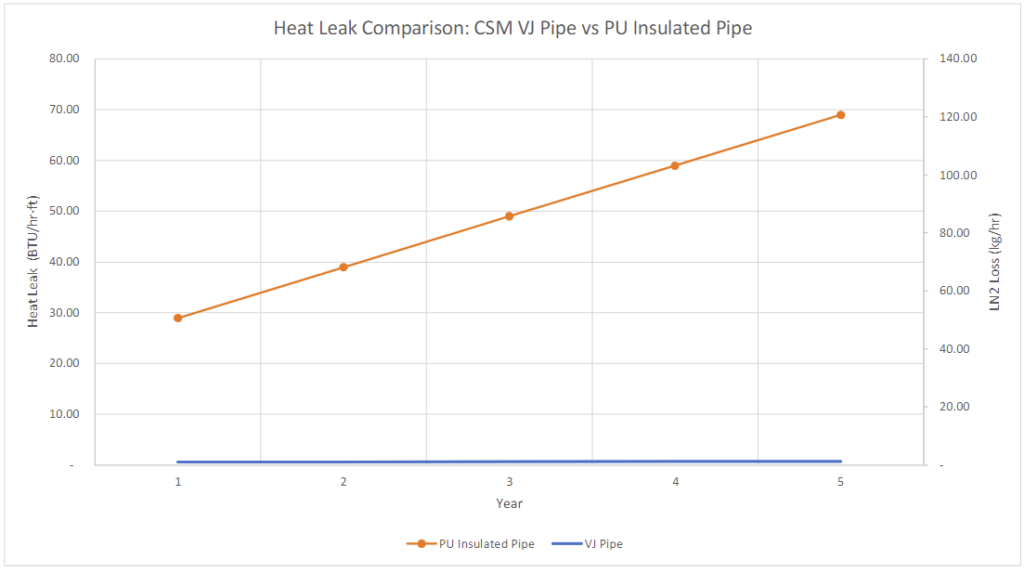
A comparison of liquid nitrogen losses between the two piping systems reveals that the vacuum insulated system significantly reduces losses compared to the copper piping system. As a result, the company can justify the additional investment cost of $120,000.00 for the vacuum insulated system within just 1.2 years, based on the ROI analysis.
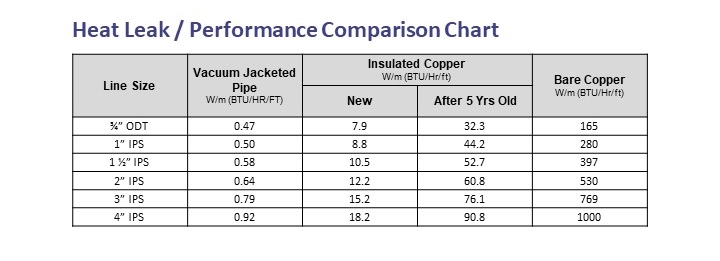
The table below summarizes the comparison of heat leaks between the Vacuum Insulated stainless steel pipe and the PU insulated copper pipe of various sizes:
Getting the Return on Your Investment
Although the initial purchase price of a VJP system can be higher than for non-vacuum systems, VJP systems typically provide a quick payback by reducing operating costs. These systems can significantly minimize the liquid losses caused by heat leaks, provide a longer life cycle than conventional foam-insulated copper piping, and do not decrease in performance over time. They can also increase production efficiency by improving the quality of the LN2 flowing through the lines (delivering colder LN2 to the use point), and can improve process safety by eliminating frosty and dripping conditions.

Advantages of Vacuum Jacketed Pipe
- Significant reduction in loss of liquid cryogen caused by heat leaks.
- Quick return on investment in new vacuum jacketed pipe installation.
- Virtually no decrease in thermal performance of vacuum jacketed pipe over 10 years.
- The StatiRigid vacuum jacketed pipe system is maintenance free for 10 years minimum.
- Longest life cycle backed by a 10-year warranty.
- Increase in freezing capacity due to improved quality of liquid nitrogen.
- Consistent delivery of liquid nitrogen at the use points due to reduction of vapor content.
- Improved process safety due to elimination of frosty and dripping conditions.


