
Technology
Static & Dynamic Vacuum Insulation
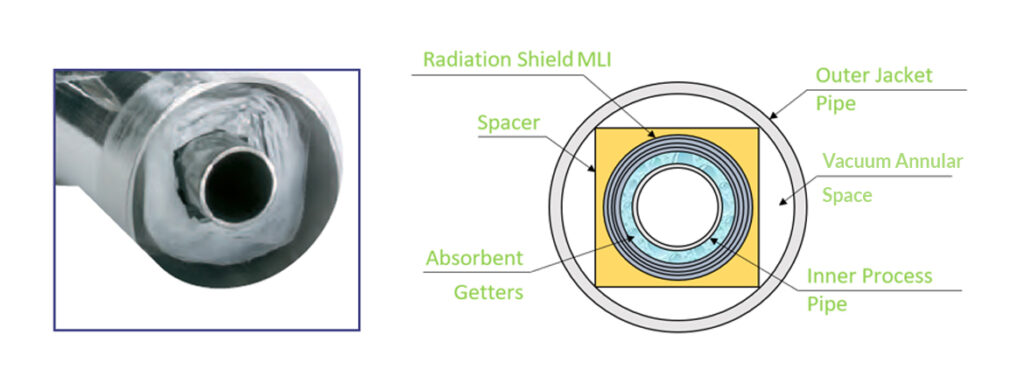
CSM employs a specially designed radiation shield with an incredibly low emissivity coefficient (ε), which indicates its exceptional ability to minimize heat emission. This radiation shield is manufactured to be just a few micrometers thick, significantly reducing the absorption of radiation heat (Qr) into the cryogenic system.
The success of the super-insulation will depend on the following parameters:
- Outgassing rate of the materials use within the vacuum annular space, such as spacers and radiation shield material
- Absorption & Adsorption rate of the getter and absorbent material use and its ability to perform long period scavenging of various type of gas molocule species form the vacuum annulus, in order to prolong the vacuum integrity
- Wrapping design and technique to avoid linear heat conduction by the radiation shield itself which will result in increase of heat leaks
- Bulk density of the radiation shield and spacer is very critical to ensure solid conduction is kept to the minimum. Increase in bulk density is know to increase solid heat conduction between layers of MLI
Types of Vacuum Insulation
We offer two types of vacuum insulation options for liquid nitrogen systems, tailored to meet your specific requirements:
- Static Vacuum: In this option, the vacuum annular space is meticulously evacuated and sealed at the factory. The static vacuum insulation is designed to maintain a consistent level of vacuum throughout its lifespan, providing excellent thermal insulation for your system. This means that once the vacuum is created and sealed, there is no need for further evacuation or maintenance on-site.
- Dynamic Vacuum: With the dynamic vacuum insulation, we provide a continuous on-site evacuation process facilitated by a vacuum pump. This type of insulation ensures that the vacuum annular space remains at an optimal level throughout the operation of your system. The dynamic vacuum insulation offers the advantage of adaptability, allowing adjustments to the vacuum level based on specific requirements or changes in operating conditions.
Understanding the differences between static and dynamic vacuum insulation options is crucial for selecting the most suitable solution for your liquid nitrogen system. Factors such as the frequency of use, required insulation performance, and operational flexibility should be considered when making this decision.
By offering both options, we aim to provide you with the flexibility to choose the vacuum insulation that aligns best with your needs. Please don’t hesitate to reach out for further information or assistance in selecting the ideal vacuum insulation solution for your liquid nitrogen system.
To gain a deeper understanding of the distinction between dynamic and static vacuum insulation, click on the blog link Dynamic Vacuum Vs Static Vacuum (csm-cryogenic.com that explores the variances between dynamic and static vacuum insulation in detail. You will find valuable insights and comprehensive information that will help you make an informed decision regarding the most suitable type of vacuum insulation for your specific needs.
Our Promise
Key benefits of multilayer super insulation
CSM employs a specially designed radiation shield with an incredibly low emissivity coefficient (ε), which indicates its exceptional ability to minimize heat emission. This radiation shield is manufactured to be just a few micrometers thick, significantly reducing the absorption of radiation heat (Qr) into the cryogenic system.
Enhanced Efficiency
Lesser boil-off of cryogenic fluid, faster investment payback
Unmatched Reliability
Elimimating two phase flow and avoiding liquid supply problem
Innovative Solutions
More stable cryogenic fluid supply
for the process
Key benefits of multilayer super insulation
CSM employs a specially designed radiation shield with an incredibly low emissivity coefficient (ε), which indicates its exceptional ability to minimize heat emission. This radiation shield is manufactured to be just a few micrometers thick, significantly reducing the absorption of radiation heat (Qr) into the cryogenic system.
- Lesser boil-off of cryogenic fluid, faster investment payback
- Elimimating two phase flow and avoiding liquid supply problem
- More stable cryogenic fluid supply for the process
How it works
While the radiation shield effectively reflects a portion of the radiation heat, it also absorbs and transmits some of the heat to the adjacent layers through solid conduction. To mitigate radial heat transfer between these adjacent layers of the radiation shield, we incorporate spacers. These spacers are made from our proprietary inorganic glass fiber material, which is both flame retardant and compatible for use with liquid oxygen, certified to meet US DOT MC-338 standards. The spacers are manufactured with a specific porosity that allows for the formation of an efficient thermal barrier in the form of interstitial vacuum spaces.
To ensure the highest quality and performance of our super insulation materials, we subject them to a meticulous degassing treatment process. This process involves subjecting the materials to extreme heat and ultra-high vacuum conditions, combined with cryogenic condensation procedures. Through this procedure, volatile hydrocarbons, moisture vapor, and lighter gas molecules are effectively removed.
The twin-layer super insulation material is then expertly applied to the process pipes using a semi-automatic wrapping machine, forming multiple layers of insulation. Careful control of the wrapping load guarantees a consistent bulk density of 25 layers/cm throughout the entire length of the pipe. To achieve the desired radiation heat barrier, more than 40 layers of the radiation shield are meticulously applied, based on our calculation model. Following this application, the product undergoes a high-temperature baking and ultra-high vacuum evacuation process to eliminate any remaining moisture and gas molecule residues from the annular space. The final outcome is a product with an extremely low apparent thermal conductivity (Kt) that is virtually free of heat leaks, thereby preventing costly boil-off of your cryogen.
Apparent Thermal Conductivity
To ensure precise heat leak calculations in cryogenic system design, we conduct tests to determine the thermal conductivity of MLI. This critical data enables accurate heat leak assessments, helping to minimize heat transfer and optimize system performance.
Request our white paper to explore how our product’s heat leak performance compares to competitive technologies in the market, including detailed calculation and insights into its superior efficiency.
To read more about super insulation, click the blog post link Super Insulation Technology (csm-cryogenic.com)
Connect for Expert Cryogenic Solutions
Looking for tailored cryogenic solutions? Our team is ready to assist you. With our innovative products and dedicated support, we can help enhance your operations and address your unique challenges. Reach out today to discover how we can collaborate for your success.